
In a world increasingly driven by technology, the medical field stands at the forefront of innovation. For tech-savvy students (20–26) fascinated by the mysteries of the human brain and nervous system, a unique and rewarding path awaits: BSS Diploma in EEG & EMG Technology.
While many consider well-known roles like lab technicians (DMLT) or OT assistants, professionals in neurophysiology are a highly specialized and in-demand group. At GK Institute of Healthcare and Skill Development (GKIHCSD), we offer this advanced diploma, positioning us as the best paramedical institute in Kolkata for those seeking a cutting-edge career in neuroscience without the complexities of NEET.
Unlocking the Brain’s Secrets: What is EEG & EMG?
The human nervous system is an intricate network of electrical signals. Electroencephalography (EEG) and Electromyography (EMG) are two powerful diagnostic tools that allow medical professionals to “listen in” on these signals.
-
Electroencephalography (EEG):
-
Concept: Imagine the brain as a complex electrical circuit. An EEG records the electrical activity of the brain, much like an electrocardiogram (ECG) records heart activity.
-
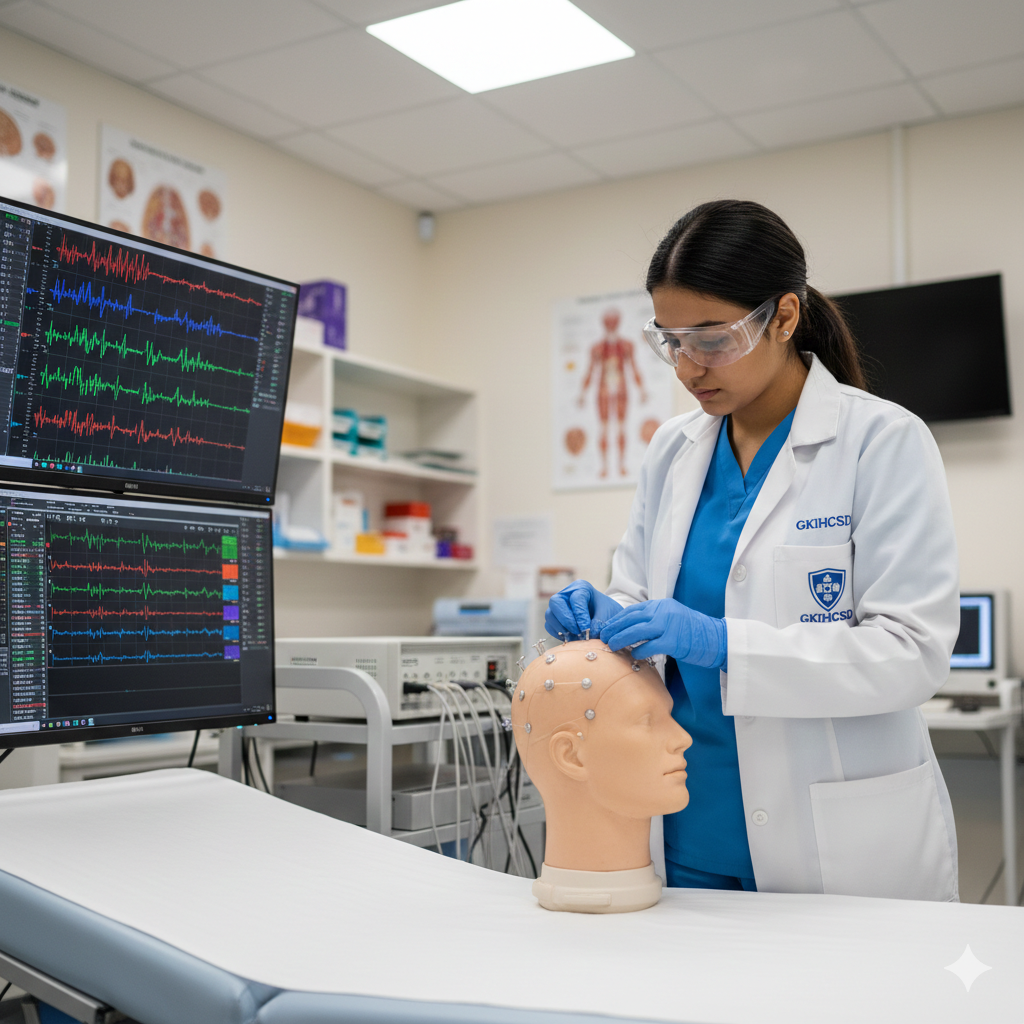
How it Works: Small electrodes are placed on the scalp. These electrodes detect the tiny electrical impulses that brain cells use to communicate.
-
Purpose: Primarily used to diagnose and monitor conditions affecting brain function, such as epilepsy (seizures), sleep disorders, strokes, and brain tumors. It helps doctors understand patterns of electrical activity to identify abnormalities.
-
-
Electromyography (EMG):
-
Concept: While EEG looks at the brain, EMG focuses on the electrical activity within muscles and the nerves that control them.
-
How it Works: Thin needle electrodes are inserted into muscles, or surface electrodes are placed on the skin. These detect the electrical signals produced by muscle fibers when they contract or are at rest.
-
Purpose: Essential for diagnosing neuromuscular disorders like carpal tunnel syndrome, pinched nerves, muscular dystrophy, and conditions affecting nerve-to-muscle communication. It helps assess nerve damage and muscle response.
-
As an EEG & EMG Technician, you are the person who operates these sophisticated machines, records these vital signals, and ensures the data is accurate for neurologists to interpret. It’s a role that requires precision, technical skill, and an understanding of human physiology.
Niche Market, High Demand: Why EEG & EMG Techs Are So Valued
When considering paramedical courses in West Bengal, many students gravitate towards more general fields. However, the specialization offered by the BSS Diploma in EEG & EMG Technology places graduates in a niche market with high demand.
Think about it:
-
Every major hospital with a neurology department needs EEG/EMG technicians.
-
Specialized neurology clinics are constantly seeking qualified personnel.
-
Sleep labs, which diagnose sleep apnea and other sleep disorders, rely heavily on EEG monitoring.
While a vast number of DMLT (Medical Laboratory Technology) graduates enter the market annually, the pool of qualified EEG & EMG technicians is significantly smaller. This creates a supply-demand imbalance in favor of the specialist. For students looking for paramedical courses after 12th without NEET that lead to a unique and secure career, this specialization offers a distinct advantage. Employers are willing to pay more for rare and specialized skills, making this a highly lucrative career choice.
GKIHCSD recognized this growing need and is proud to be among the few institutions in Kolkata offering such an advanced and industry-relevant program. This makes us a standout among the top 10 paramedical colleges in Kolkata for specialized training.
Tech Meets Healthcare: A Perfect Blend for the Modern Student
Are you someone who enjoys working with computers, understands the logic of machines, and has a keen interest in how technology can solve complex problems? If so, the BSS Diploma in EEG & EMG Technology is where tech meets healthcare perfectly.
-
Operating Advanced Equipment: You’ll be trained on state-of-the-art neurophysiology equipment, learning how to calibrate, troubleshoot, and operate these sensitive machines to get precise readings.
-
Data Acquisition and Analysis: The role involves setting up electrodes, monitoring signals on computer screens, and ensuring artifact-free recordings. You’ll learn how to identify different wave patterns and understand what they represent.
-
Software Proficiency: Modern EEG/EMG systems rely on specialized software for recording, storing, and reviewing data. You will become proficient in using these essential tools.
-
Problem-Solving: If a signal isn’t clear or equipment malfunctions, you’ll apply your technical knowledge to identify and resolve issues, ensuring patient tests are not compromised.
This blend of technology and direct patient care provides a stimulating environment for those who love hands-on work with high-tech gear. It’s a career that combines scientific principles with practical application, appealing to analytical minds.
The GKIHCSD Edge: Specialized Training in Neuroscience
Finding high-quality, specialized training in fields like neurophysiology can be challenging. Many institutes offer general paramedical courses, but only a select few provide the depth required for advanced specializations. GK Institute of Healthcare and Skill Development (GKIHCSD) is one of the premier institutes in Kolkata that offers this specialized BSS-affiliated diploma in EEG & EMG Technology.
What gives GKIHCSD its unique edge?
-
BSS Affiliation: Our diploma is not just a local certificate. It’s affiliated with Bharat Sevak Samaj (BSS), a National Development Agency promoted by the Government of India. This national recognition ensures your qualification is respected across the country and even internationally, a key factor when looking at paramedical courses in West Bengal.
-
Dedicated Neurophysiology Lab: We invest in specific equipment for EEG and EMG training, allowing students to gain practical experience on the same machines they will encounter in a hospital setting.
-
Expert Neurologists & Technicians as Faculty: Our instructors are not just academicians; they are experienced neurologists and senior neurophysiology technicians who bring real-case scenarios and up-to-date protocols into the classroom and lab.
-
Focused Curriculum: The curriculum is meticulously designed to cover both the theoretical foundations of neuroanatomy and neurophysiology, as well as the practical skills required for operating EEG and EMG equipment, patient preparation, and basic data interpretation.
-
Early Mover Advantage: By choosing GKIHCSD, you are stepping into a less crowded, higher-value segment of the paramedical market, setting yourself apart from the general crowd. This truly makes us the best paramedical institute in Kolkata for this specialization.
Diverse Career Pathways: From Sleep Labs to Research Facilities
A BSS Diploma in EEG & EMG Technology opens doors to a variety of specialized and impactful career pathways. Your expertise will be sought after in diverse medical settings:
-
Neurology Clinics & Hospitals: This is the most common path, working directly with neurologists to diagnose conditions like epilepsy, multiple sclerosis, neuropathies, and myopathies. You’ll conduct routine EEGs and EMGs for patient evaluations.
-
Sleep Labs: Sleep disorders are a growing health concern. EEG monitoring is a crucial component of polysomnography (sleep studies), where technicians record brain waves, eye movements, and muscle activity to diagnose conditions like sleep apnea, insomnia, and narcolepsy.
-
Epilepsy Monitoring Units (EMU): These specialized units within hospitals require technicians for long-term EEG monitoring to pinpoint the origin of seizures, especially for patients being considered for surgery.
-
Neurophysiology Research Facilities: For those with an interest in contributing to medical science, research centers often employ EEG/EMG technicians to assist in studies exploring brain function, cognitive processes, and neuromuscular diseases.
-
Rehabilitation Centers: EMG is frequently used in physical medicine and rehabilitation to assess nerve and muscle function, guiding therapy for patients recovering from injuries or strokes.
-
Intraoperative Monitoring: In some complex surgeries (e.g., spinal cord surgery), EEG and EMG are used to monitor nerve function in real-time, helping surgeons avoid nerve damage. This highly specialized role offers excellent compensation.
